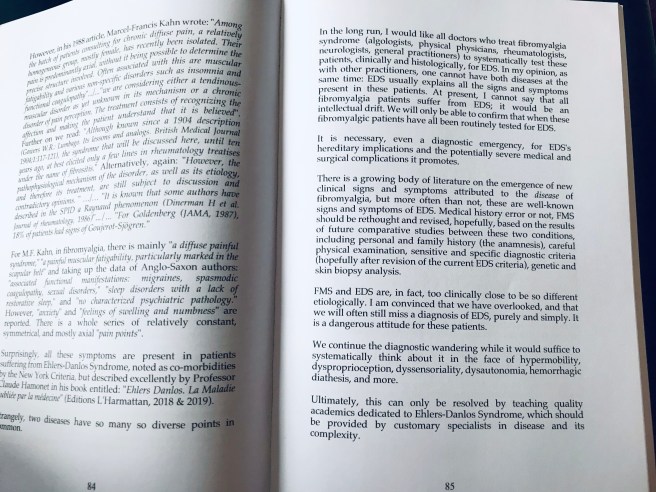
We must emphasise that many patients around the world are misdiagnosed as having Fibromyalgia, and these patients should be routinely tested for Ehlers-Danlos Syndrome (EDS).
Some articles mention figures of 50-75% of mislabelling of these EDS patients. Furthermore, in Fibromyalgia, ultrastructural analysis of the dermis by transmission electron microscopy (TEM) is strictly normal (unlike in patients with Ehlers-Danlos syndrome).
Most patients with Ehlers-Danlos syndrome have been previously diagnosed with Fibromyalgia.
We need to make all doctors and carers in general aware of this reality.
The various treatments and aids proposed for Ehlers-Danlos syndrome(s) are specific and often different from those prescribed for Fibromyalgia.
The delay between the first signs and symptoms and the diagnosis of EDS is on average more than 15 to 20 years, worldwide.
This reality causes a great and intolerable suffering of these patients; we can only notice through the press and social networks that some people (and even artists around the world) are suffering and dying, without having had, perhaps, a diagnosis of EDS.
So let's test these patients for an EDS.....And not wait so long to do it!
Let us all continue to inform and train carers, but also friends and relatives, about this disabling and often "invisible" disease. It can lead to very serious disabilities.
"Transforming Ehlers-Danlos Syndrome: What is the disease's history? What are its clinical signs and symptoms? Is Ehlers-Danlos Syndrome really that rare? Is it necessary to modify the disease's current classification? How is it transmitted to children? How does it evolve over the course of a lifetime? How is it managed? What treatments are available to help patients improve their quality of life? How can confusing emergency situations for both patients and caregivers be managed?
These are only a few of the questions that this book attempts to answer precisely, with specific treatment regimens adapted to the unique situations that any family physician or specialist may encounter. Dr. Stéphane Daens collaborated with thirty specialists from around the world to get a better understanding of this disease, which remains underdiagnosed and poorly understood. Patients experience severe medical wandering and a more than two-decade delay in diagnosis because of the lack of knowledge about the disease. Although it is often confused with Fibromyalgia, Ehlers-Danlos Syndrome necessitates a completely different approach to treatment and management. It is a hereditary condition with currently unclear transmission pathways. This book introduces novel concepts involving the disease transmission and evolution over a lifetime. Aside from classical genetics, the role of epigenetics, mast cells, autonomous nervous system, proprioception, nutrition, and microbiota appears unavoidable.
Main author: Doctor Stéphane Daens. Co-authors: Doctor Isabelle Dubois-Brock, Professor Claude Hamonet, Professor Daniel Frédy, Doctor Trinh Hermanns-Lê, Mr. Olivier Hougrand, Professor Jaime F. Bravo, Professor Stephen W. Porges, Doctor Katja Kovacic, Doctor Jacek Kolacz, Mr. David Leroy, Mr. Dominique Ouhab, Professor Michel Vervoort, Professor Andràs Pàldi, Doctor Daniel Grossin, Doctor Pradeep Chopra, Doctor Norman Marcus, Doctor Jessica Pizano, Doctor Michael P. Healy, Professor David Levine, Professor Anne Maitland, Doctor Georges Verougstraete, Doctor Georges Obeid, Doctor Kambyse Samii, Doctor Richard Amoretti, Doctor Emmanuel Tran-Ngoc, Doctor Michel Horgue, Professor Antonio Bulbena-Vilarrasa, Professor Carolina Baeza-Velasco, Professor Andrea Bulbena-Cabré, and Mrs. Dominique Weil.
"This book is not only an anthology of what is currently known or said about Ehlers-Danlos; it is also a practical essay for both practitioner and patient. Prof. Claude Hamonet, Physical Medicine and Rehabilitation, Paris, France.
"In reading this volume, I have gained an appreciation for the progress that has been made in understanding and treating EDS." Prof. Stephen W. Porges, Neuroscience, North Carolina, USA.
"Doctors, patients, and anyone else interested in EDS will find everything they have ever wanted to know about this disease in this fascinating book. Prof. Michel Vervoort, fundamental geneticist, Paris, France.
"Here is a new bible for EDS patients, that serves as a beacon, lighting the way for those in pain, often despair, and hiding in plain sight of the modern, biomedical community." Prof. Anne Maitland, Internal Medicine, Allergy & Immunology, New York, USA
We remind you to renew your annual subscription to GERSED Belgium.
This is €25/year for patients and €40/year for carers.
What are your annual fees for?
It is thanks to you and your membership fees and donations that we can operate, pay for the gersed belgium websites, write and publish books and ebooks on EDS, have material for our non-profit association.
Without you, nothing is possible...
We are making great strides at GERSED Belgium to make the EDS known and recognised worldwide.
It is thanks to your personal commitment, your donations, your membership fees and the activities you carry out to raise money for our association. And we thank you very much for this.
Let's stick together!
As a reminder, the bank account and contact details of gersed Belgium :
May this year 2022 bring you joy and happiness and above all a better management of your pains.
Let's tame Ehlers-Danlos syndrome and make it an indestructible force!
Our knowledge of this disease is growing by the day.
Let's all continue to support each other and show solidarity, in order to raise awareness and recognition of this disease around us.
Let's all support this just cause around the world.
All of us at our level can improve things. Improve knowledge, inform our relatives and health care providers. We all have a role to play, we all have our place in this fight.
We would like to draw your attention to the new nomenclature for mast cell activation: following recent publications, we are now talking about NC-MCD (Non-Clonal Mast Cell Disorder) when the blood tryptase level is normal.
The NC-MCAS is used if the tryptase is above the norm.
MCAS is said to be "primary" if there is a clonal disease (mastocytosis = mast cell cancer due to proliferation of a clone following a mutation = clonal mast cell disorder mastocytosis) or secondary (e.g. when IgE is elevated, or if there is an underlying disease such as generalized urticaria, autoimmune disease or other) or idiopathic MCAS (always with elevated tryptase) if no other contributing cause is established. With a normal tryptase (which is most often the case in EDS), we speak of "non-clonal mast cell disorder" and not MCAS.
To be correct in the title, it should be non-clonal mast cell activation syndrome or non-clonal mast cell disorder (not a cancer): NC-MCAS or NC-MCDs depending on the case.
In order to qualify as NC-MCDs/NC-MCAS, there must be symptoms, even if frustrating, in at least two to three systems: skin, digestive system, respiratory system, cardiovascular system, neurological system or urogenital system.
NC-MCDs (and more rarely NC-MCAS) are present in approximately 80% of patients with Ehlers-Danlos syndrome.
The treatment of NC-MCD or NC-MCAS is the same and must be adapted on a case by case basis.
Good to all,
Dr Stéphane Daens. President of GERSED Belgium, coordinator of a national network of experts Orphanet / INSERM